2026 Urban and Rural Water Environment Management Practice Case Study: Sedimentation–Flotation System for the Expansion Project of Meicun Water Treatment Plant in Weifang City
Date:2026-08-21Source:Views:
ProjectName: Weifang Meicun Water Treatment Plant Expansion Project – Sedimentation-Flotation System
Project Location: Weifang Meicun Water Treatment Plant
Applicant: Wuxi Gongyuan Environmental Technology Co., Ltd.
Commissioning Date: May 2023
Treatment Capacity: 125,000 tons/day
Process: Pre-ozonation – Sedimentation-Flotation – Ultrafiltration – Activated Carbon
Serving Population: 70% of the urban population in Weifang City
Key Performance Indicator: Removal rate of non-settling algae> 95%.The influent water quality for the flotation tank shall have a turbidity of ≤5 NTU; the required effluent water quality shall have a turbidity of ≤1 NTU.
1. Project Overview
The Meicun Water Treatment Plant was established in 1989, covering an area of 120 mu, and commenced formal operation in 1992. In recent years, the water consumption in the central urban area of Weifang has grown steadily year by year; consequently, the demand for domestic and industrial water has exceeded the maximum supply capacity of the Weifang Municipal Water Supply Company. As a result, some areas have experienced insufficient water pressure or even water supply interruptions—a challenge that becomes particularly acute during the peak summer water supply period. The current water supply capacity is no longer sufficient to meet the domestic water needs of the local residents, adversely affecting their quality of life. To thoroughly resolve this long-standing issue during the peak summer water supply period and effectively accommodate the city's anticipated, continuously growing water demand, the Weifang Municipal Water Supply Company invested approximately RMB 500 million in July 2022 to launch the expansion project for the sedimentation and flotation system at the Meicun Water Treatment Plant. The project was designed by the Shanghai Municipal Engineering Design and Research Institute (Group) Co., Ltd. Following modifications based on the existing water purification process, the plant was connected to the grid and put into operation in May 2023. As a result, the plant's daily water supply capacity will be increased from the current 100,000 cubic meters to 200,000 cubic meters, and its corresponding water treatment capacity will also be upgraded accordingly to 200,000 cubic meters.
2. Natural Conditions
Weifang City is located in the eastern part of the Shandong Peninsula, spanning latitudes 35°32′37°26′ N and longitudes 118°10′120°01′ E. It borders the TaiYi Mountains to the south and the Laizhou Bay of Bohai Sea to the north. To its east lie Qingdao and Yantai; to its west are Dongying and Zibo. Serving as a strategic thoroughfare linking inland Shandong with the peninsula, the Jiaoji Railway runs eastwest across the city. The straight line distance from Weifang to Jinan, the provincial capital, is 183 km to the west, and 410 km northwest to Beijing, the national capital.
Weifang has six major surface water systems: the Wei River, Mi River, Bailang River, South Jiaolai River, North Jiaolai River and Zi River. Hundreds of other rivers and streams are tributaries of these main watercourses, with the Xiaoqing River being the only transboundary river. Restricted by natural conditions, surface runoff is primarily recharged by atmospheric precipitation. The multiyear average annual runoff depth of the city is 177.3 mm, 3 % higher than Shandong provincial average of 172.2 mm. Runoff exhibits considerable interannual and intraannual fluctuations: the maximum annual runoff depth reaches 252.3 mm while the minimum is merely 22.9 mm, nearly a 10 fold difference. Floodseason runoff accounts for 85 %90 % of the total annual runoff. Geographically, runoff gradually decreases from southeast to northwest, registering 332 mm in the southern hilly area and only 95 mm in the coastal zone, a 237mm gap equivalent to a 2.5fold variation. The multiyear total surface runoff volume averages 3.067 billion cubic meters.
Weifang falls within the North Temperate Monsoon Zone. With land to its back and sea in front, it is jointly influenced by the Eurasian Continent and the Pacific Ocean, featuring a continentality index above 50 %. It has a warmtemperate monsoon semihumid continental climate, characterized by cold winters, hot summers and four distinct seasons. Spring is windy with scarce rainfall; early spring sees volatile temperatures with frequent late spring cold snaps, whereas late spring warms rapidly. Summer is hot and rainy with high temperature and humidity. Autumn is crisp and pleasant, yet late autumn tends to be dry. Winter is cold and dry with frequent cold winds. Under typical monsoon influence, seasonal temperature variation is distinct. The municipal annual average temperature stands at 12.3 °C. January is the coldest month with mean temperature of 3.3 °C, and July the hottest at 26.0 °C. Temperatures rise fast in spring and drop sharply in autumn.
3. project objective
The Capacity Expansion Project for the Meicun Water Treatment Plant, undertaken by Weifang Municipal Water Supply Co., Ltd., adopts a dual-process water purification technology scheme. Raw water sourced from the Xiashan Reservoir can be treated using either Process 1 – Air flotation tank + Straight-stream sedimentation tank + V-shaped sand filter + Ozone/Hydrogen peroxide/Activated carbon filter – or Process 2 – Sedimentation-air flotation tank + Ultrafiltration + Ozone/Hydrogen peroxide/Activated carbon filter. Following the retrofitting of the existing water treatment processes, the plant's daily water supply capacity will be increased from the current 100,000 cubic meters to 200,000 cubic meters; correspondingly, its water treatment capacity will also be raised to 200,000 cubic meters. Currently, the plant's treatment processes are operating steadily; testing has confirmed that all 106 effluent quality parameters comply with the national drinking water quality standards. Additionally, the Weifang Municipal Urban Management Bureau has introduced new design effluent quality requirements: effluent turbidity shall be ≤ 0.3 NTU, there shall be no abnormal odors or tastes, total organoleptic odor shall be ≤ 10 ng/L, methylisobutyl ketone-2 shall be ≤ 10 ng/L, and precursor substances for disinfection by-products—such as trihalomethanes, haloacetic acid, and bromates—shall be reduced by an additional 50% compared to the current baseline; testing has confirmed that all the aforementioned effluent quality requirements are fully met.
4. Technical Process Solution
This project employs a dual-process water purification system: Process 1 – Air flotation tank + Parallel-flow sedimentation tank + V-shaped sand filter + Ozone/Hydrogen peroxide/Activated carbon filter; Process 2 – Sedimentation-air flotation tank + Ultrafiltration + Ozone/Hydrogen peroxide/Activated carbon filter.
Equipment Principle
(1) Precipitation flotation tank
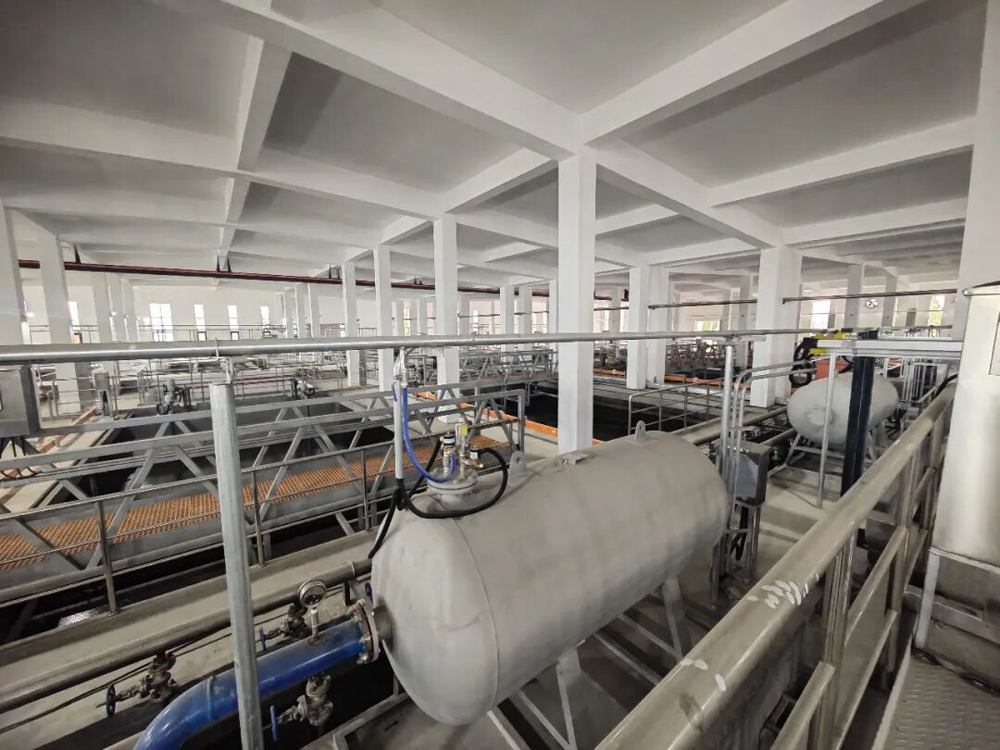
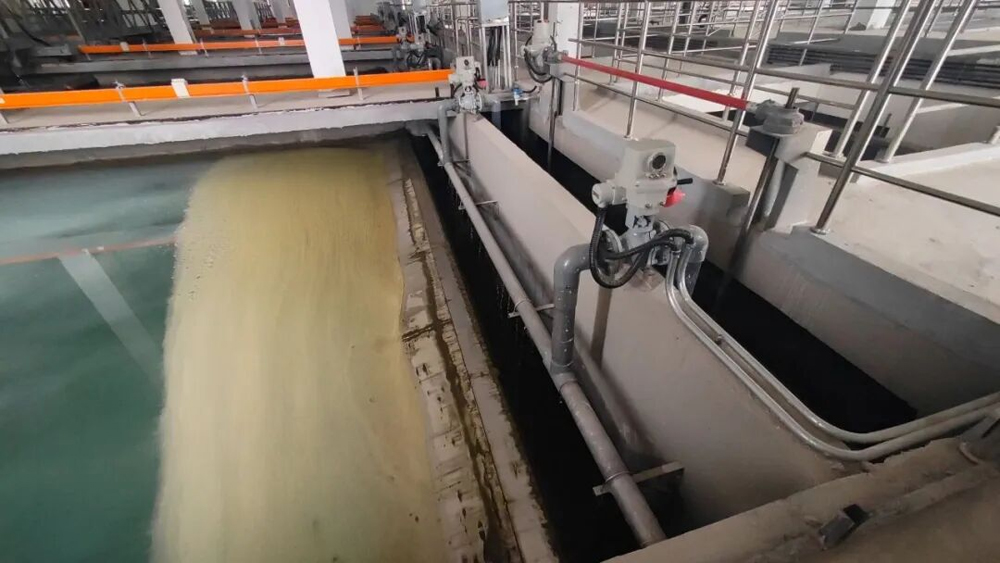
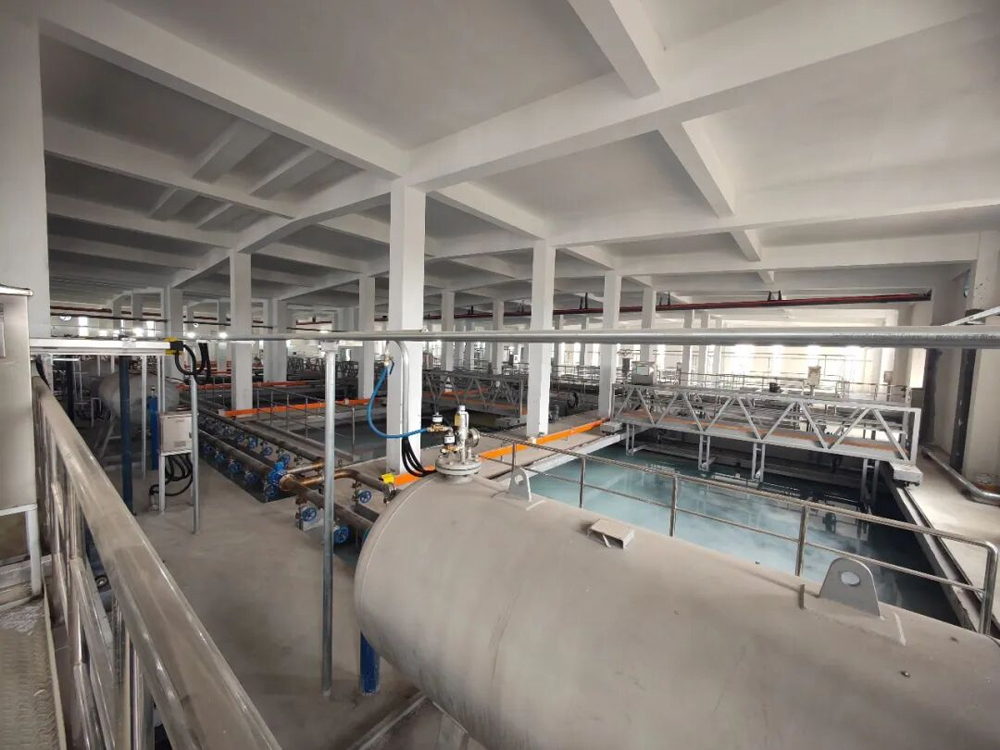
This tank is a combined unit integrating sedimentation and flotation processes; the sedimentation zone is primarily used to remove suspended solids, colloidal substances, and other impurities from the water, while the flotation zone utilizes a large number of microbubbles to capture and adsorb fine particles and colloidal matter from the water, thereby driving the impurities upward for solid–liquid separation. The sedimentation–flotation tank employs an intensive layout design, which effectively reduces the land area required by the plant.
(2) Immersive Ultrafiltration Membrane Workshop
This system employs submerged membrane modules consisting of hollow-fiber membranes mounted on vertical or horizontal frames, along with collection pipes installed at the top and bottom of the frames. The ultrafiltration membrane can virtually remove all bacteria, viruses, protozoa, algae, and other aquatic organisms, while also minimizing turbidity and eliminating large-molecule organic compounds; it represents the most effective technology for ensuring the microbial safety of drinking water.
(3) Ozone Generation and Contact Reaction Comprehensive Workshop
Ozone, as a powerful oxidizing agent, can oxidize refractory macromolecular organic compounds into low-toxicity or non-toxic small-molecule substances by generating highly oxidizing free radicals (primarily hydroxyl radicals, OH·). This process is widely used for removing COD (Chemical Oxygen Demand), BOD (Biochemical Oxygen Demand), phenol, cyanide, iron, and manganese from water; it also enables deodorization, decolorization, and sterilization of water bodies. This integrated workshop combines the pump house, ozone contact tank, ozone generation room, flushing equipment room, and power distribution room into a single unit, with a design capacity of 200,000 m³/d.
(4) activated carbon filter
This process serves two primary functions: first, it adsorbs and removes low-molecular-weight organic compounds generated through ozone oxidation; second, by leveraging the oxygen-supplying capability of ozone, it maintains an oxygen-rich environment within the activated carbon filter bed, thereby promoting the proliferation of aerobic microorganisms on the surface of the activated carbon particles and facilitating the formation of biofilms and microbial communities. Through mechanisms such as biological adsorption and oxidative degradation, this approach significantly enhances the activated carbon's capacity to remove organic matter. This process is currently the most widely adopted and technologically mature and reliable advanced treatment method in China's water purification industry.
Equipment Features
(1) Precipitation flotation tank
The design capacity is 100,000 m³/d; the system comprises two tanks, each with a capacity of 50,000 m³/d. Each tank is independently divided into three compartments, and the overall structure consists of two levels: the upper level houses the mechanical mixing tank, the zigzag plate flocculation zone, the settling tank effluent guide channel, and the air flotation zone; the lower level serves as the sedimentation zone. Each sedimentation and flotation tank is equipped with its own mechanical mixing tank, and the hydraulic retention time is approximately 63 seconds. The flocculation process employs zigzag plate flocculation, with a total flocculation time of 19 minutes, divided into three flocculation stages. The upward flow velocity in the air flotation contact zone is 16.5 mm/s, the contact time is 121.2 seconds, the dissolved air return ratio is 10%, and the air flotation effluent is discharged through perforated plates installed at the lower part of the tank.
(2) Immersive Ultrafiltration Membrane Workshop
The design capacity is 110,000 m³/d; the membrane filtration system consists of two rows arranged in a symmetrical configuration, with each row containing five compartments – for a total of 10 compartments – and the membrane design flux is 24.8 L/(m²·h).
(3) Ozone Generation and Contact Reaction Comprehensive Workshop
The lifting pump room is integrated with the ozone contact tank; it is located on the west side of the ozone contact tank and is equipped with four submersible axial-flow pumps operating in a "3-operating, 1-backup" configuration.
The ozone contact tank is located adjacent to the central lifting pump room and features a fully enclosed structure divided into two independent compartments; its effective water depth is 7.0 m, and the total contact time is 15 min. Aeration and contact are achieved across three sections of the tank using a microporous aeration system; the ozone released from the contact tank is collected under negative pressure and then decomposed into oxygen via a thermal catalyst before being discharged into the atmosphere. The ozone generator unit is installed above the ozone contact tank and is designed for a capacity of 200,000 m³/d; it is equipped with three ozone generators, each with a capacity of 20 kg/h and a rated power of 170 kW; the system operates in a "two-operating, one-backup" mode, allowing all three generators to run simultaneously during emergency conditions.
The flushing facility is located to the north of the ozone contact tank and is equipped with a flushing water pump system and a blower system: three flushing water pumps are installed, operating in a "2-operating, 1-backup" configuration; two blowers are installed, operating in a "1-operating, 1-backup" configuration.
(4) Filter
This project employs a single flap filter tank with a design capacity of 200,000 m³/d. The filter tank is arranged in a single row, consisting of nine compartments; each compartment has a filtration area of 96 m² and an empty bed filtration velocity of 11.1 m/h. The activated carbon used for water purification has a particle size ranging from 8 to 30 mesh; the filter layer thickness is 2.78 m, and the empty bed residence time is 15 min. Below the activated carbon layer, there are, in sequence, a sand filtration layer with a thickness of 0.6 m and a support layer with a thickness of 0.45 m. The activated carbon-sand filter tank utilizes a bread-pan pipe water and air distribution system; the backwashing method employs a combined air-water backwashing technique. The backwashing water source is drawn from the backwashing pump station; the backwashing water flow rate is controlled through the coordinated operation of multiple running pumps under variable-frequency drive (VFD) control; the backwashing air source is supplied by the blower station.
5. Promotional Value
Upon the stable commissioning of the expansion project, the water supply security capacity and water quality in the central urban area of Weifang have been enhanced, and the safety of water supply has been significantly improved. This fully meets the daily water usage demands of residents and provides strong support for the social stability and economic development of Weifang. The project's ecological benefits have also met the expected targets; while increasing water treatment capacity, it has also reduced environmental emissions.
(1) Economic feasibility verification for investment and operations
Through process optimization, the water plant's self-use rate has been reduced to 1.5%, which not only lowers operating costs but also improves water resource utilization efficiency, fully demonstrating the project's long-term economic viability.
As the core component of this project, the capacity expansion also facilitated the simultaneous upgrade of water source pumping stations—such as the Luodutun Pumping Station—and the urban water distribution network, establishing a comprehensive water supply upgrade model covering the entire supply chain from source to end-user.
(2) Breakthrough demonstration of technology and production capacity
Without requiring additional land acquisition, this project increases its daily water supply capacity from 100,000 tons to 200,000 tons, effectively doubling its water supply scale. Notably, the project's land use indicator is merely 0.032 m²/(m³·d) – significantly lower than the national standard of 0.055 m²/(m³·d) – making it an exemplary model of "intensive capacity expansion" for cities with limited land resources.
The project employs an innovative "Dual-Process Water Purification Technology" that integrates advanced "Ozone–Biological Activated Carbon" advanced treatment methods. This combined process delivers remarkable effectiveness, enabling the stable control of effluent water turbidity below 0.1 NTU – merely one-tenth of the national standard limit – thereby achieving a qualitative transformation from "compliant water" to "premium water." This approach holds significant reference value for the upgrading and modernization of aging water treatment plants.
(3) Social benefits as a benchmark for emergency management
Following its expansion, the water treatment plant now bears the responsibility of supplying water to 70% of Weifang's urban population, effectively alleviating the supply-demand imbalance during the city's summer peak water usage period and creating room for the city's future development.
During the final grid-connection phase of this project, a water supply interruption lasting 34 hours, affecting a population of 1.3 million, was required. To address this, the local government deployed more than 120 water delivery vehicles and established an integrated emergency support system combining sectoral and regional approaches, ultimately ensuring the stability of social order. This successful implementation of a large-scale urban emergency water supply operation has also provided valuable public management experience for similar projects.
Project Images